
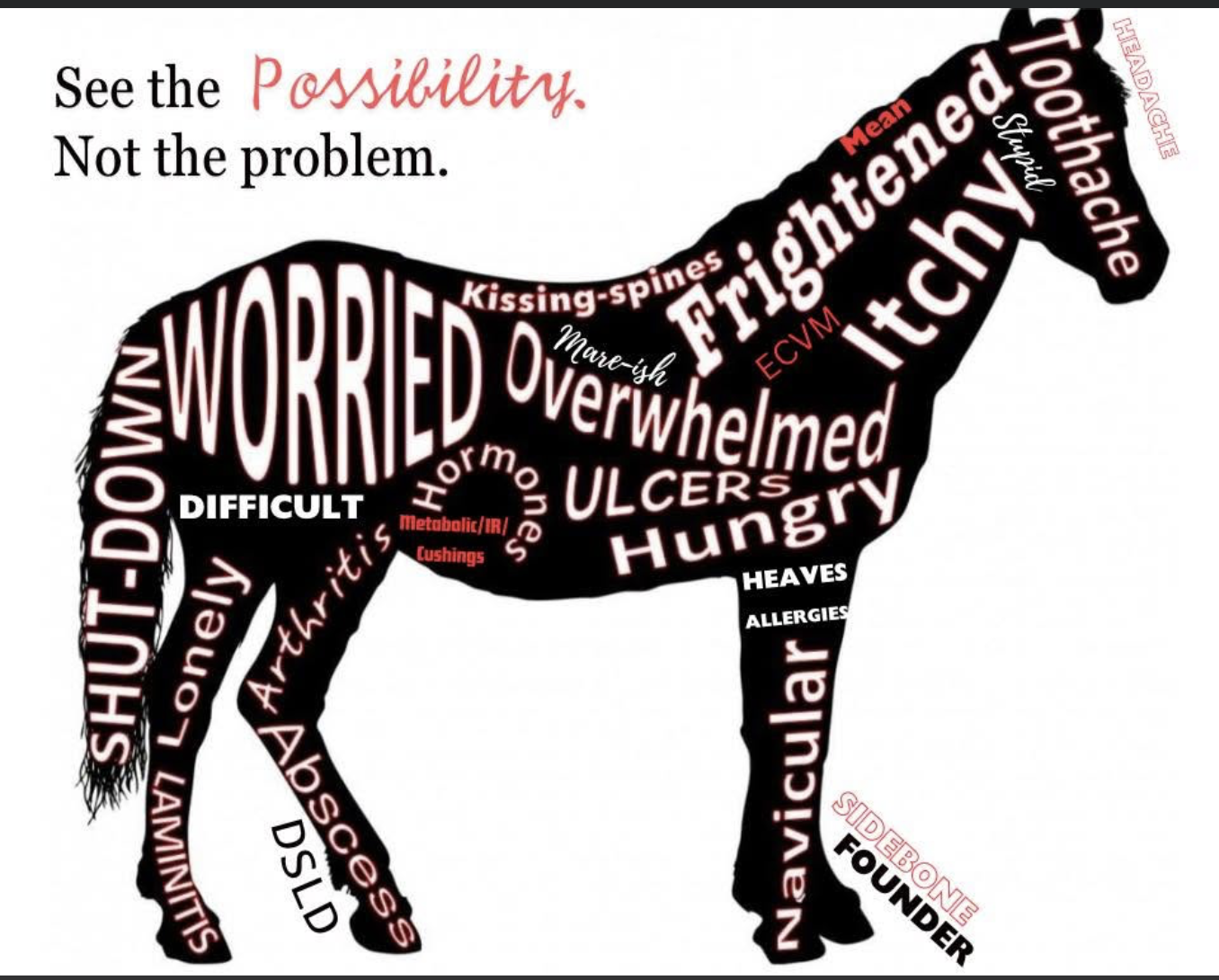
When we receive disappointing health news about our horse or we are struggling to find answers to an ongoing issue, it can be overwhelming! I've been there, and I'm sure many other horse guardians have too. We start researching, asking questions, seeking opinions, and doing everything we can to help. Sometimes we find ourselves so consumed by what's wrong that it becomes difficult to see anything else.
But what if we shifted our focus a little?
Years ago, I was advised to euthanize my heart horse, Deja, because of a neurological condition. I was heartbroken. But rather than accepting that there were no other possibilities, I began exploring what else I could do to support her. I started looking at her as a whole horse, rather than focusing solely on her neurological challenges. I explored different ways to support her body, her nervous system, her nutrition, and her overall well-being. I began paying closer attention to what was going well, what she could do, rather than everything she couldn't.
And over time, she didn't just survive. She thrived.
That experience changed the way I look at horses and it's something I still carry with me today.
A diagnosis can give us valuable information. It helps us understand what may be happening within the body and can guide us toward the appropriate care and support. I'm certainly not suggesting we ignore it or pretend that limitations don't exist. But I do wonder is how often we become so focused on a diagnosis, a particular problem area, or even a label we've given our horse, that we stop seeing the bigger picture?
We see the horse with arthritis. The horse with metabolic challenges. The horse with kissing spines. The horse with neurological problems. Or perhaps the horse we've come to describe as difficult, anxious, or stubborn.
And while some of those labels can provide useful information, they don't tell us everything about the horse standing in front of us.
What about everything that's going well?
Maybe our horse is moving more comfortably than they were a month ago. Maybe they're enjoying time with their herd, playing in the pasture, or showing more curiosity about their surroundings. Maybe we've noticed subtle improvements in their energy, attitude, or willingness to engage with us.
Those things matter, too.
And what about the areas we haven't explored yet?
Could their nutrition use a little more support? Is their environment allowing enough movement, social interaction, and opportunities to simply be a horse? Are there ways to encourage play, curiosity, or relaxation? Could we look more closely at how the rest of the body is functioning and compensating?
Sometimes the answers aren't found by focusing harder on the problem itself, but by stepping back and looking at the whole horse.
The body has a remarkable capacity to heal when given the right support. We may not always be able to change a diagnosis but we can often influence how a horse experiences life with it.
I think this is an important distinction. Supporting our horses doesn't always mean fixing something or returning them to what they once were. Sometimes it means helping them find more comfort, confidence, and enjoyment in the life they have today.
When we're constantly looking for what's wrong, we become very good at finding it. We notice every uneven step, every moment of discomfort, every little thing that doesn't seem quite right. And observation is important. Those details help us understand our horses and recognize when something needs attention.
But what if we gave just as much attention to what's going well?
What if we noticed the small improvements and stayed curious about the possibilities we haven't explored? Because, what we focus on expands!
It doesn't mean ignoring the diagnosis or overlooking the challenges. It simply means making room for something else alongside them. I don't believe we need to choose between acknowledging what's wrong and looking for what's possible. We can do both.
And perhaps when we begin to shift our focus, we start seeing our horses a little differently. Not as a collection of problems to solve but as individuals with their own strengths, challenges, preferences, and possibilities.
Because our horses are so much more than the labels we give them.
Let's remain curious about the possibilities, even when the path forward looks different than we expected.
